


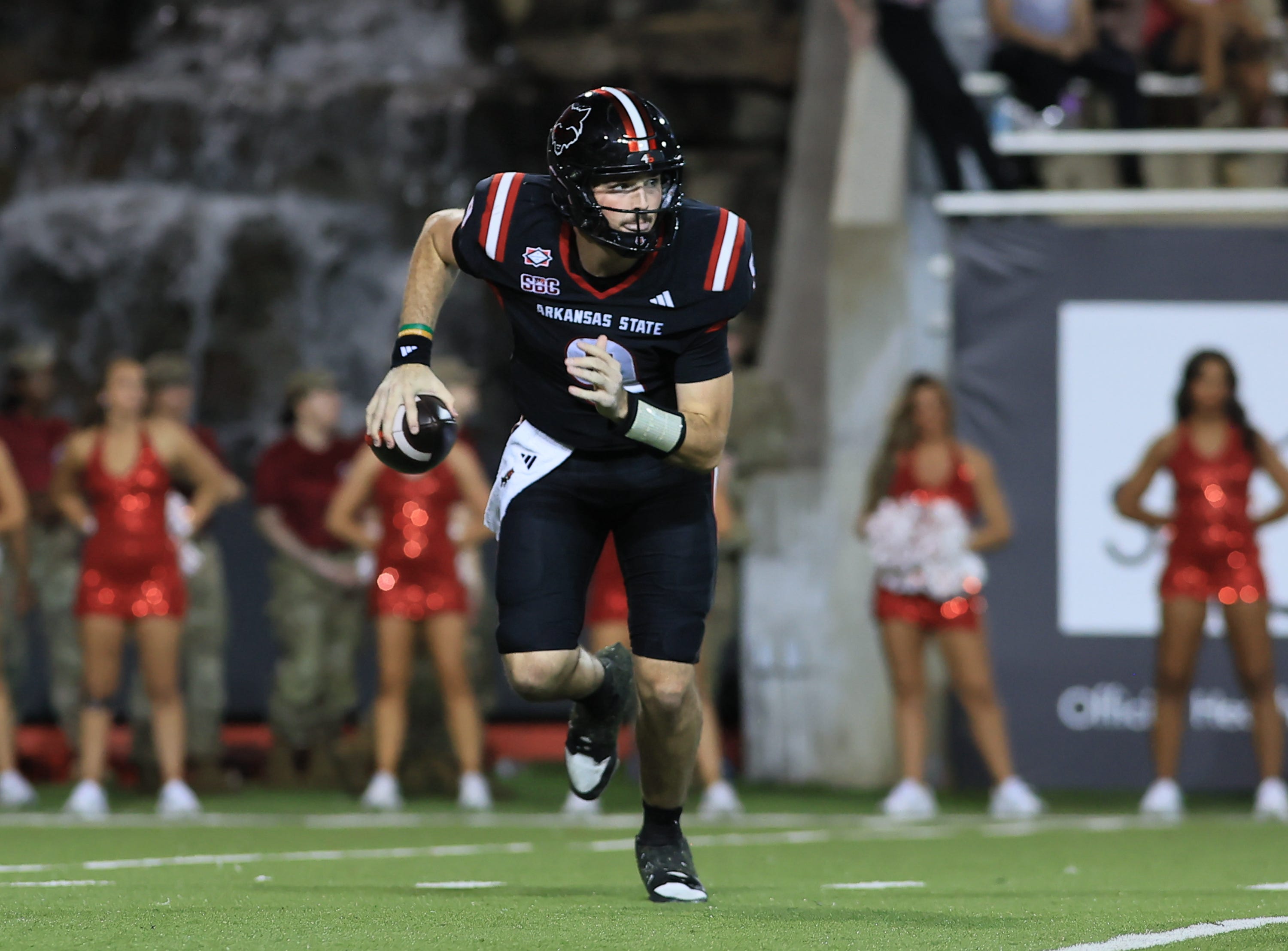
Trey Owens did not need to throw for 400 yards or account for five touchdowns for Arkansas State coach Butch Jones to come away impressed with his quarterback Saturday night.
Instead, Owens did something Jones believes could be even more important to the Red Wolves’ long-term success.
He managed the game.
Owens completed 24 of 31 passes for 244 yards and a touchdown, added a 2-yard touchdown run and, perhaps most importantly, did not turn the football over as Arkansas State rallied for a 17-14 victory over Kennesaw State at Centennial Bank Stadium.
“I thought Trey Owens really managed the game, stepped up for us,” Jones said.
For a quarterback still settling into his first season running the Arkansas State offense, Saturday represented another step in his development.
Owens did not force throws when plays broke down. He escaped pressure when necessary, threw the ball away rather than putting it in danger and helped the Red Wolves navigate a game in which possessions were limited and mistakes were magnified.
“I think Trey did a good job of not forcing the action,” Jones said. “There was a number of times where he was able to escape and throw the football away, and that’s how you manage a football game.”
That has become a recurring theme for Jones when discussing Owens.
The Texas transfer arrived at Arkansas State with physical tools, but Jones has repeatedly stressed the importance of playing quarterback beyond simply making throws. The position requires Owens to manage situations, understand when to take chances and when not to, and keep the Red Wolves out of the mistakes that can change games.
Saturday may have provided his best example yet.
Kennesaw State’s defense made Arkansas State work for everything it got. The Red Wolves finished with only nine possessions, and several promising drives were derailed by negative plays, penalties or missed opportunities.
Arkansas State still finished with 363 yards, and Owens completed 77.4% of his passes.
More importantly, A-State did not give the Owls a short field with a turnover.
“Monumental,” Jones said when asked about playing turnover-free football. “You can’t turn the football over.”
Jones said Arkansas State must be a team that does not beat itself, and Owens’ decision-making was a significant part of accomplishing that against Kennesaw State.
Owens’ night was not defined by one long touchdown pass.
Instead, he consistently took what Kennesaw State gave him.
Hunter Summers became one of his primary targets, including on a 14-yard touchdown in the second quarter that gave Arkansas State a 7-0 lead.
Jones said Kennesaw State initially gave Summers free access at the line of scrimmage, and the Red Wolves were content to take the available completions. Some of those throws came on run-pass options, while others were designed drop-back passes.
“Hunter did a good job and Trey did a good job,” Jones said.
Kennesaw State eventually adjusted its coverage in the second half, forcing Arkansas State to adjust with it.
Owens also showed he could respond when Arkansas State fell behind.
Kennesaw State took a 14-7 lead with 4:24 remaining in the third quarter after Boogie Woods II scored on a 6-yard run.
The Red Wolves answered immediately.
Owens directed a seven-play, 76-yard drive and finished it himself with a 2-yard touchdown run with 1:19 left in the third quarter. The extra point tied the game at 14.
Arkansas State later took the lead on Clune Van Andel’s 33-yard field goal with 8:19 remaining.
Owens’ work was not finished.
After Kennesaw State missed a potential tying field goal with 2:59 remaining, Arkansas State needed to drain the clock against a defense that knew the Red Wolves wanted to run.
Owens’ responsibility shifted from moving the offense through the air to managing the clock and the huddle.
Jones noticed.
With the 40-second play clock winding down, Owens consistently waited until the final seconds to take the snap. Arkansas State had to get into the huddle, communicate the call, reach the line, make its adjustments and still avoid snapping the football too early.
Those seconds mattered because Kennesaw State still had its timeouts.
“When Trey snapped the ball with two seconds left on the 40-second clock, I thought our players did a really good job of managing the huddle when we got out of the huddle, getting lined up, making the calls, making the adjustments,” Jones said. “And Trey did a good job in terms of managing the offense all night.”
Arkansas State ultimately picked up three first downs and never gave the football back.
Solomon Baggett provided the most important conversion with a 12-yard run on third-and-6 with 1:52 remaining, but Owens was responsible for keeping the entire operation organized as the Red Wolves finished the game in victory formation.
It was a different kind of quarterback performance from the one Owens produced in the season opener at Memphis, when he threw for 325 yards, or against West Georgia, when he threw multiple touchdown passes for the first time at Arkansas State.
But it may have been just as important.
Jones praised Owens after the West Georgia victory for managing that game as well, emphasizing that Arkansas State’s offensive formula requires protecting the football and maximizing a limited number of possessions.
Owens also showed against West Georgia that he could quickly distribute the football against pressure. Jones praised his ball placement on perimeter throws and his ability to get the ball out quickly when the Wolves faced internal blitzes.
Kennesaw State provided another test.
The result was a quarterback who completed nearly 80% of his passes, accounted for both Arkansas State touchdowns and avoided the mistake that could have changed a three-point game.
There remains plenty for Owens and the offense to improve.
Jones pointed to pre-snap penalties and negative-yardage plays that repeatedly put Arkansas State behind the chains. He also said the Red Wolves must become more consistent at finishing drives with touchdowns.
Those issues will become even more important as Arkansas State enters Sun Belt Conference play.
But four games into Owens’ first season directing the offense, Jones is seeing progress in an area that does not always show up in a quarterback’s passing statistics.
Owens is learning how to manage games.
Saturday night, that helped Arkansas State win one.